
The contemporary television landscape is frequently saturated with young adult book-to-screen adaptations, yet rarely does a series achieve the delicate, razor-thin equilibrium required to balance a beloved, trope-heavy sports romance with profound, emotionally resonant explorations of trauma, consent, and healing. Amazon Prime Video’s Off Campus, which premiered its eight-episode first season on May 13, 2026, has instantly emerged as a definitive, masterclass triumph in this highly specialized narrative niche. Based on the globally successful, multi-platinum book series by Elle Kennedy, the television adaptation navigates the high-stakes, hyper-competitive environment of collegiate hockey, the complex realities of modern intimacy, and the arduous, non-linear journey of reclaiming one’s stolen identity.
To fully comprehend the dense narrative architecture and the emotional devastation of the season’s final moments, a comprehensive Off Campus ending explained is absolutely required. The season finale operates not merely as a neat romantic resolution, but as a meticulously crafted, explosive setup for the rapidly expanding universe of Briar University. By subverting traditional romantic comedy tropes—specifically the transactional “fake-dating” mechanism—creators and showrunners Louisa Levy and Gina Fattore have engineered a narrative where the internal, emotional stakes consistently eclipse the athletic ones.
This exhaustive, in-depth analytical report deconstructs the intricate lore, the complex character psychologies, the hidden production subtexts, and the shocking final twists of the season. By synthesizing every narrative clue, historical flashback, and psychological subtext from the first eight episodes, this analysis provides definitive explanations for the show’s most ambiguous twists, explores the brutal realities of the characters’ pasts, and forecasts the catastrophic events poised to unfold in the officially greenlit Season 2.
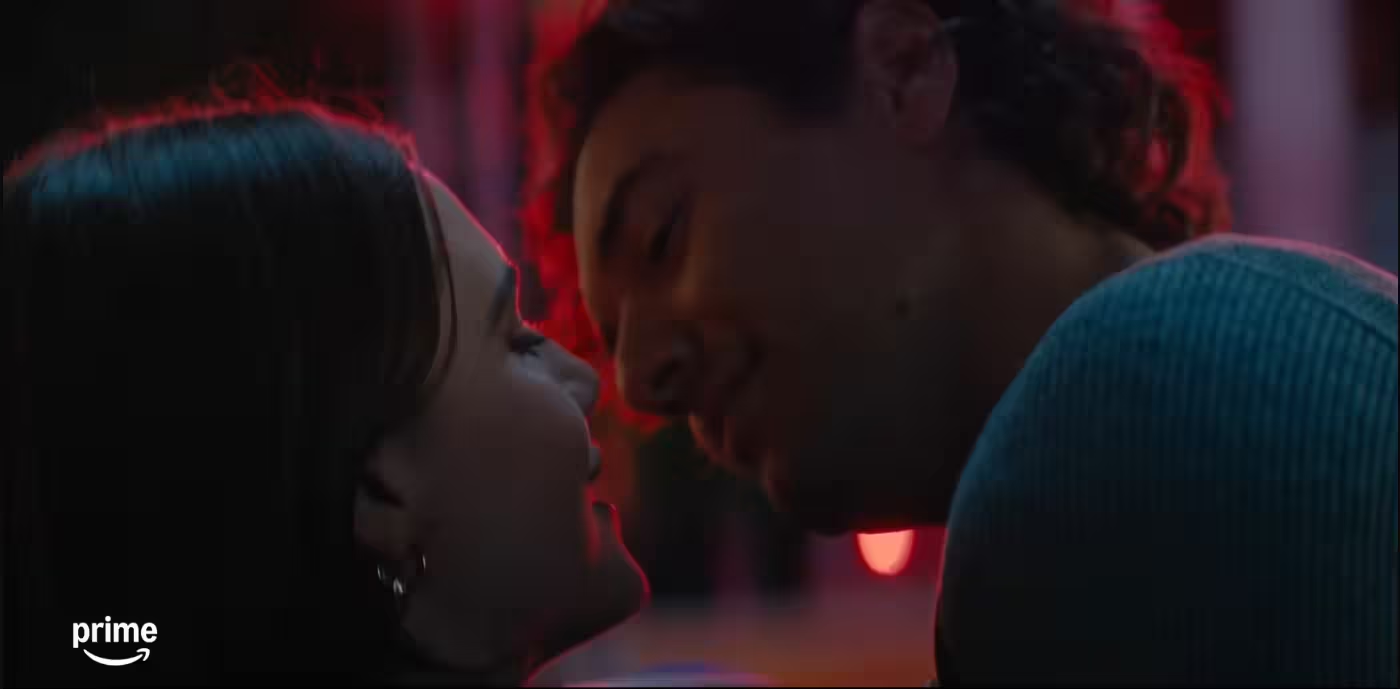
The Genesis of Briar University: Production, Strategy, and Directorial Vision
To appreciate the nuanced storytelling of Off Campus, one must first examine the creative forces and streaming strategies steering the production. Developed for television by creator Louisa Levy—known for her work on The Flight Attendant—the series represents a bold evolution of Elle Kennedy’s source material. Amazon MGM Studios and Temple Hill Entertainment recognized a distinct vacuum in the television market for high-quality, coming-of-age romance that does not shy away from adult themes.
Prime Video’s strategy is clear: position the platform as the undisputed home of the modern cinematic romance. Following the runaway, culture-defining success of The Summer I Turned Pretty, Amazon sought to capture an older, collegiate demographic. Off Campus perfectly fills this void. Levy’s vision explicitly intertwines the energetic pacing and visual aesthetics of early-2000s romantic comedies—citing 10 Things I Hate About You as a primary tonal influence—with a rigorous, modernized approach to consent culture and psychological trauma.
The show fundamentally understands that the appeal of Briar University extends far beyond the ice rink. The visual language of the series treats the campus as an isolated microcosm of early adulthood, a pressure cooker where every major character hides behind a specific coping mechanism. Furthermore, the decision to drop all eight hour-long episodes simultaneously allowed audiences to experience the narrative as an unbroken exploration of vulnerability, making the climax of the finale significantly more impactful.
Comprehensive Cast and Character Dynamics: The Psychology of Briar
The phenomenal success of Off Campus is inextricably linked to its elite ensemble cast. The production demanded a highly specific, grueling tonal calibration, requiring actors to oscillate seamlessly between sharp comedic timing, intense athletic choreography, and primal, abject emotional breakdowns. The chemistry between the leads must anchor the entire narrative structure.
The following table details the primary cast, their respective characters, and their profound narrative functions within the overarching mythology.
| Actor | Character | Narrative Function and Psychological Profile |
|---|---|---|
| Ella Bright | Hannah Wells | A deeply talented music major and assault survivor. Her arc centers on reclaiming her creative voice, which she locked away to survive. She utilizes fierce independence as a shield against emotional vulnerability. |
| Belmont Cameli | Garrett Graham | The star captain of the Briar Hawks hockey team. He hides immense psychological trauma behind an arrogant, hyper-competent facade, absolutely terrified of inheriting his abusive father’s violence. |
| Mika Abdalla | Allie Hayes | Hannah’s best friend and emotional anchor. She masks her deep-seated fear of emotional commitment by compartmentalizing her life and aggressively insisting on purely casual romantic encounters. |
| Stephen Kalyn | Dean Heyward-Di Laurentis | A wealthy, charismatic hockey player. His casual playboy persona completely shatters when he inadvertently falls in love with Allie, triggering his deepest, unexamined insecurities. |
| Antonio Cipriano | John Logan | Garrett’s loyal best friend and teammate. He struggles with his own identity and leadership capabilities, constantly living in Garrett’s shadow while harboring a quiet, painful crush on Hannah. |
| Jalen Thomas Brooks | John Tucker | The pragmatic, grounded anchor of the hockey house. He provides emotional stability and comedic relief, often observing the chaotic, self-destructive choices of his roommates from a safe distance. |
| Josh Heuston | Justin Kohl | The brooding campus musician and Hannah’s initial love interest. He serves as the narrative catalyst for the fake-dating arrangement, representing the idealized, safe version of romance Hannah thinks she wants. |
| Charlie Evans | Hunter Davenport / Carter | A highly talented late-season hockey recruit. He acts as the ultimate disruptive force in the finale, carrying an unresolved, bitter history with Dean and serving as Allie’s secret hookup. |
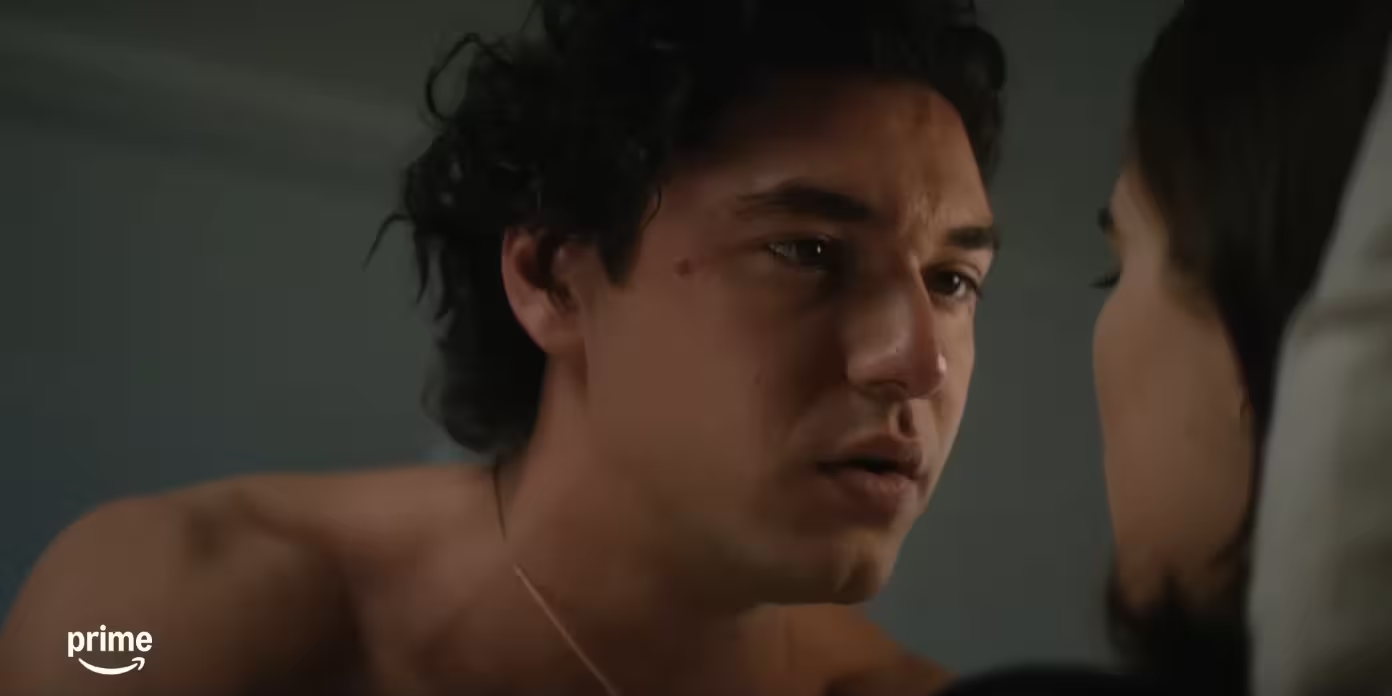
The Anatomy of a Deal: Fake Dating as a Mechanism for Survival
The narrative engine of Off Campus is built upon one of literature’s most enduring tropes: the transactional, fake-dating arrangement. However, any thorough Off Campus ending explained must recognize how Louisa Levy brilliantly weaponizes this trope. The relationship between Hannah Wells and Garrett Graham does not exist merely to generate comedic misunderstandings; it functions as a highly controlled, low-stakes psychological safe room for two deeply traumatized individuals.
The Initial Collision
The series opens with a literal and metaphorical collision. Hannah, working backstage at the arena and lost in her music, accidentally wanders into the men’s locker room, catching Garrett completely exposed in the shower. This initial embarrassment sets the stage for a dynamic defined by seeing past the surface. Shortly after, Garrett, facing academic probation that would destroy his hockey career, discovers that Hannah was the only student to pass their rigorous philosophy class.
Hannah’s initial refusal to tutor Garrett establishes her boundaries, but her financial desperation forces her hand. Her academic scholarship has been revoked due to budget cuts, leaving her with one option: winning the university’s pop showcase to secure funding. Simultaneously, she is agonizingly infatuated with Justin Kohl, a campus musician, but her trauma renders her incapable of initiating a conversation.
Garrett proposes the titular deal: she tutors him to ensure his spot on the ice, and he will pretend to be her boyfriend to leverage Justin’s jealousy.
The Illusion of Control
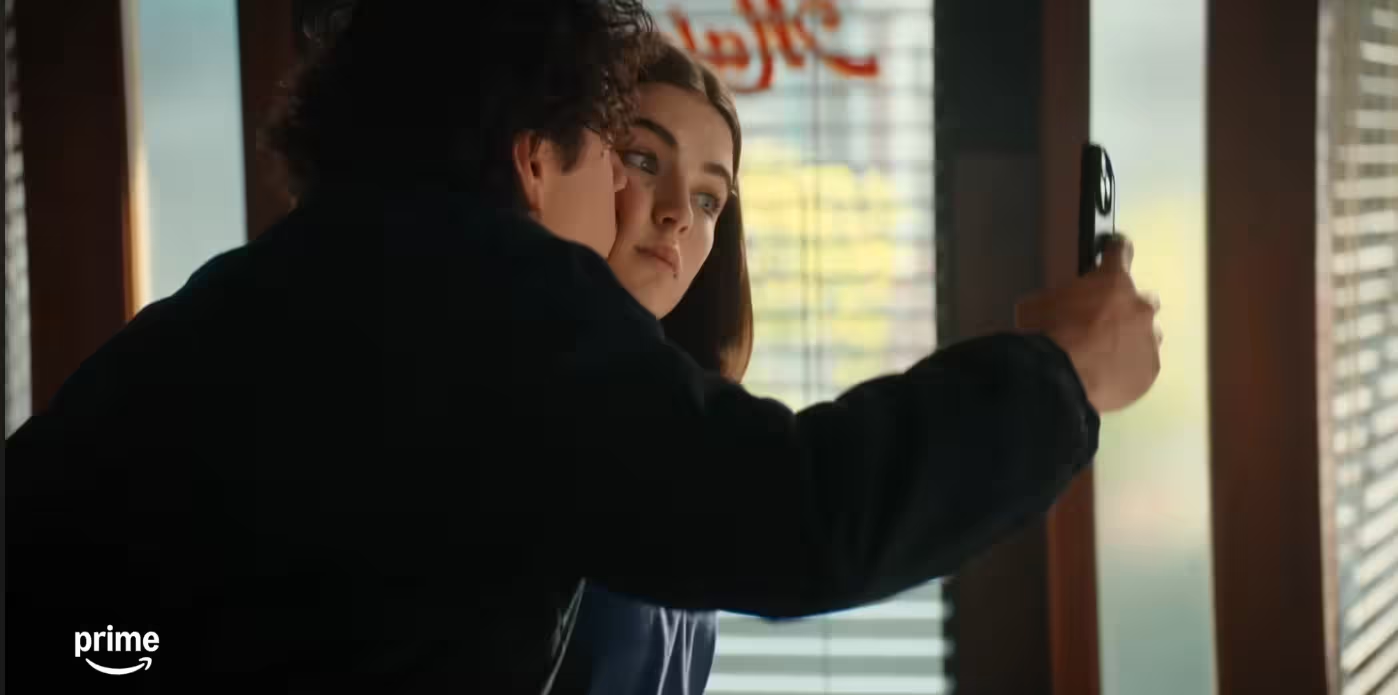
What makes the fake relationship compelling is how aggressively Garrett tries to control the narrative. He approaches the fake romance with the same tactical precision he uses on the ice. He orchestrates a highly structured “hard launch,” coordinating social media optics via the “Fifthline” hockey gossip account run by a student named Jules. Garrett even coaches Hannah on how to act naturally when he invades her personal space, setting up rehearsals that blur the lines of performance and reality.
The culmination of this performance occurs at a Cape Cod-themed block party. Dressed as a magician and a bunny, the two deliberately stage intimate moments to convince both Justin and Jules of their authenticity. When Jules confronts Hannah, attempting to expose the relationship as a fraud, Hannah successfully defends the act by kissing Garrett on the cheek.
Yet, the true intimacy develops in the quiet, unscripted spaces. Following the party, a mundane argument over who sleeps on the bed versus the floor in Garrett’s room softens into genuine comfort. They scroll through memes, laugh, and watch live performances of The Beaches side-by-side. Garrett subtly realizes he finds immense comfort in Hannah’s presence, marking the exact moment the transactional walls begin to crumble.
Deep Psychological Profiling: Trauma, Consent, and Reclaiming Identity
An accurate Off Campus ending explained requires a deep, unflinching dive into the psychological bedrock of the series. The show operates on the profound premise that healing does not mean the magical erasure of trauma; it means refusing to let that trauma function as the entirety of one’s identity.
Hannah Wells: The Silenced Composer
Hannah’s internal conflict is externalized through a severe, multi-year bout of writer’s block. Once a prolific composer, she has been unable to complete original lyrics for years, forcing her to rely on covers like her emotional rendition of Elton John in the empty arena. The series slowly and respectfully reveals that this creative paralysis is directly linked to an assault she survived in high school. She was drugged and raped by an athlete at a party.
To survive the aftermath in a town that refused to support her, Hannah compartmentalized the trauma so severely that she accidentally closed off the core of her artistic identity. Showrunner Louisa Levy was adamant that the series would never depict the assault on screen, focusing instead entirely on Hannah’s survival and recovery.
Hannah’s journey is not a narrative where the male lead “saves” the broken woman. Instead, Garrett provides a non-judgmental, secure space that allows Hannah to save herself. This dynamic is vividly demonstrated in the show’s most profoundly sensitive sequence. Hannah, realizing she has developed genuine feelings for Garrett, asks him for a massive favor: she wants him to help her overcome a psychological block regarding physical intimacy, specifically her inability to achieve an orgasm since her assault.
Garrett’s response is a masterclass in modern consent modeling. He entirely removes his ego from the equation. He does not initiate physical contact; instead, he physically distances himself across the room, allowing Hannah to guide the moment and maintain total, absolute control of her body and the environment. By creating this safe harbor, Garrett allows Hannah to reclaim her physical autonomy.
Garrett Graham: The Inheritance of Violence
Conversely, Garrett’s trauma is active, loud, and constantly threatening to consume him. To the outside world, he is the golden boy of Briar University. Internally, he is a man drowning in the shadow of his father, Phil Graham, a legendary former NHL player who was physically and emotionally abusive to Garrett and his late mother.
Garrett’s entire personality—his rigorous physical discipline, his arrogant charm, his obsessive need to control the narrative—is a desperate psychological defense mechanism designed to prove he is nothing like his father. He lives in perpetual terror that violence is a genetic inheritance.
The emotional tipping point for Garrett occurs during the Thanksgiving episode. Reluctantly attending dinner at Phil’s opulent estate, Garrett notices faint bruises on the wrist of Phil’s new fiancée, Cindy. The horrific realization that the cycle of abuse is continuing shatters Garrett’s carefully maintained emotional equilibrium. He attempts to rescue Cindy, but she defends her abuser. On the drive back to campus, Garrett suffers a complete psychological breakdown, confessing to Hannah the full extent of the abuse he suffered and his paralyzing fear of his own anger.
Off Campus Ending Explained: The Climax, The Brawl, and The Breakup
The narrative tension of the first season detonates in episode seven, setting up the devastating conditions for the finale. The Briar Hawks are scheduled for a high-stakes game against rival team St. Anthony’s. On the opposing roster is Aaron Delaney.
While Hannah had previously disclosed the nature of her trauma to Garrett, she had intentionally withheld the identity of her attacker, knowing Garrett’s protective instincts could jeopardize his career. However, the island of safety they built is breached.
During the game, Delaney notices Hannah in the crowd. Skating near Garrett, Delaney cruelly calls Hannah a liar. In a fraction of a second, the intellectual and emotional pieces lock into place in Garrett’s mind. The resulting sequence is brutal, visceral, and defining. Garrett drops his hockey stick, completely loses cognitive control, and violently beats Delaney on the ice until he is forcibly dragged away by coaches and teammates, his face and hands covered in blood.
The immediate fallout is catastrophic. Garrett is suspended for four games. Following a disciplinary hearing that also uncovers a video of Garrett participating in an unsanctioned practice with the Boston Bruins, the NCAA forces the Hawks to forfeit all their previous season wins.
However, any definitive Off Campus ending explained must highlight that the hockey suspension is not what destroys Hannah and Garrett’s relationship. It is Garrett’s profound terror at his own reflection. Following the fight, Phil Graham approaches Garrett outside the locker room, proudly praising his son for his aggressive, violent outburst.
This is Garrett’s absolute nightmare realized. He broke his control, he blacked out, and in his mind, he became his father. Convinced that his capacity for violence makes him a fundamental danger to Hannah, Garrett abruptly and coldly breaks up with her. He does not stop loving her; he severs the relationship under the tragic, misguided belief that he is actively protecting a survivor of violence from a man who could potentially snap.
Off Campus Ending Explained: The Showcase and The Reconciliation
The final episode of the season forces every major character to confront a singular, terrifying question: Who are you when your primary distraction is stripped away?
For Garrett, the loss of hockey forces him into a terrifying liminal space. Coach Jensen fundamentally challenges Garrett, asking not if he is capable of winning, but if he even loves the sport anymore. Without the ice to channel his aggression and mask his pain, Garrett is forced to sit with his own identity.
Simultaneously, Hannah is forced to navigate her heartbreak without retreating into her former, silent shell. The culmination of her character arc occurs at the university’s pop showcase. Initially terrified, Hannah almost skips the event entirely. However, she realizes that perfection is irrelevant; the absolute necessity is to stop hiding from the world.
Hannah takes the stage alone and performs “Girl That I Am,” an original, deeply personal composition constructed entirely through live looping and vocal layering. The musical arrangement is profoundly metaphorical: Hannah is literally building the foundation of her voice, layer by layer, in front of a live audience. The lyrics explicitly address her assault, her survival, and the emotional awakening she experienced. While she places second and loses the primary scholarship, she secures a paid internship that allows her to remain at Briar. The victory is internal.
The emotional payoff arrives in the parking lot post-performance. Garrett, having done the grueling internal work to separate his identity from his father’s shadow, is waiting for her. He has handed the temporary captaincy of the hockey team over to Logan—a massive symbolic gesture proving he no longer needs to control everything to feel safe.
Garrett asks for a second chance, communicating a vital shift in his perspective: he does not want Hannah to fix his damage, but he genuinely wants to be better for her. The season concludes its primary romantic arc with Hannah kissing him, solidifying a relationship built on radical honesty and mutual healing rather than transactional convenience.
The Shocking Twist: Dean, Allie, and the Hunter Davenport Catalyst
While Hannah and Garrett find emotional stabilization, the Off Campus ending explained must address the absolute detonation of the secondary storyline involving Dean Di Laurentis and Allie Hayes.
In a massive structural departure from Elle Kennedy’s novels—where Dean and Allie’s romance does not occur until the third book, The Score —showrunner Louisa Levy pulled their dynamic forward, weaving it through the background of Season 1. What begins as a secretive, casual hookup resulting from an accidental phone call during Drunk Shakespeare night quickly spirals into a deep, unacknowledged emotional dependency. They sneak around Malone’s bar, hide in bathtubs to evade Tucker, and share surprisingly tender moments in Dean’s luxury New York apartment over the Thanksgiving holiday.
The tragedy of Dean and Allie is that both are fiercely terrified of the exact same thing: the loss of independence. Allie, fresh out of a suffocating, long-term relationship with her ex-boyfriend Shawn, proposes a devastating rule to protect herself: she demands they sleep with other people to ensure their arrangement remains strictly casual. Dean, who has spent his entire college career utilizing sex as a barrier against emotional vulnerability, is secretly heartbroken by this request, but his ego forces him to agree.
In the finale, Dean experiences a profound, terrifying realization: he is genuinely in love with Allie and finds himself entirely incapable of sleeping with anyone else. He approaches her at Malone’s bar to confess his feelings, ready to surrender his playboy persona entirely.
The timing is catastrophic. Allie, operating under their previous agreement and desperate to prove she isn’t emotionally tethered, tearfully confesses that she has already completed the “assignment”—she slept with a guy named Carter.
The identity of Allie’s partner is the ultimate narrative twist. The man walks into the bar, and it is revealed that “Carter” is actually Hunter Davenport (played by Charlie Evans), a newly recruited hockey star for the Briar Hawks. The revelation instantly sparks a violent, chaotic bar brawl between Dean and Hunter, as Allie watches in complete, devastating shock.
This twist is mathematically perfect television screenwriting. Hunter Davenport is not a random extra; he is the elite player the team desperately needs to salvage their ruined season, he shares an unexplained, bitter history with Dean’s sister Summer, and he has just slept with the woman Dean loves. The season ends by trapping these characters in an inescapable pressure cooker: they must play hockey together, live in proximity, and navigate a profoundly toxic emotional fallout in the upcoming season.
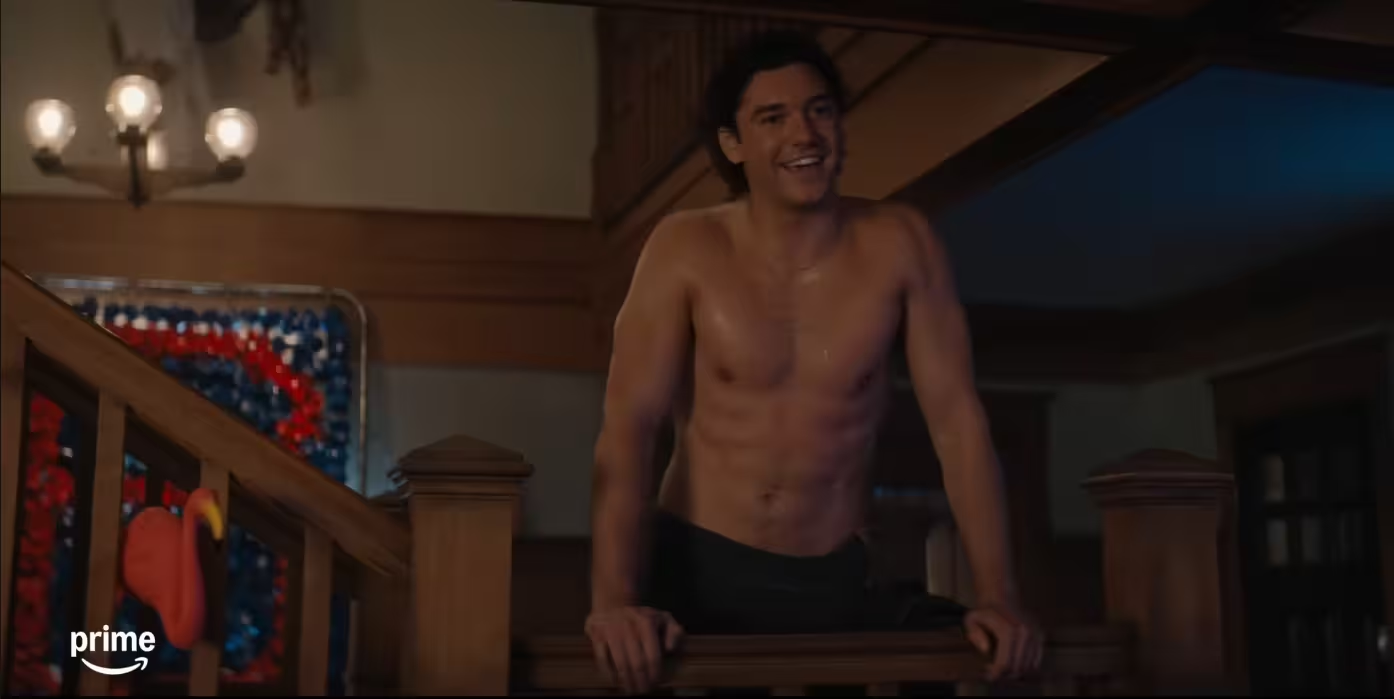
Hidden Secrets: Adaptation Changes from ‘The Deal’
For fans of the original literary universe, the television adaptation introduced several highly calculated changes to modernize the narrative, address contemporary collegiate issues, and sustain long-term television pacing. Analyzing these shifts is crucial for a complete Off Campus ending explained.
1. The NIL Era Modernization
In Elle Kennedy’s 2015 novel The Deal, the core conflict leading to the breakup stems from external financial blackmail. Garrett’s abusive father threatens to cut off Garrett’s university tuition if Hannah does not end the relationship. Hannah, sacrificing her own happiness, leaves Garrett to protect his hockey career and future.
In 2026, the landscape of collegiate athletics has fundamentally shifted due to Name, Image, and Likeness (NIL) regulations. College athletes can now legally profit from their status. Garrett is depicted actively engaging in brand sponsorships—such as his lucrative Liquid IV deal orchestrated with Logan—and has access to an independent trust fund from his grandfather upon turning 21.
A financial threat from his father is no longer logically viable. Therefore, Levy brilliantly shifted the breakup to originate from Garrett, rooting the separation in profound psychological fear (becoming his father) rather than external financial blackmail. This change deepens Garrett’s character arc, making his eventual return to Hannah an act of internal triumph over his trauma, rather than simply overcoming a financial hurdle.
2. The Acceleration of the Timeline
The decision to weave the plot of The Score (Book 3) into the background of The Deal (Book 1) is a masterstroke of television structuring. By establishing Dean and Allie’s secret romance in Episode 5, the show ensures the audience is equally invested in the secondary characters, preventing the narrative from stalling when Garrett and Hannah are separated. It transforms the series from a singular romance into a true ensemble drama.
3. The Grace Ivers Easter Eggs
Throughout the season, Logan’s lingering, unspoken crush on Hannah acts as a subtle source of tension. However, the show quietly lays the groundwork for the second book, The Mistake. The announcement that actress India Fowler has been cast as Grace Ivers confirms that Logan’s ultimate romantic arc is imminent. Furthermore, subtle background details—such as the marshmallow-in-the-taco tradition Logan shares with his sister Jules while visiting their mother in rehab—serve to deeply humanize Logan, preparing the audience for his transition to a complex leading man.
The Real-World Impact: Fandom Toxicity and Prime Video’s Intervention
The explosive popularity of Off Campus has mirrored the massive real-world impact of other YA juggernauts, but it has also brought a darker element of fandom culture to light. As audiences became fiercely protective of the characters and the actors portraying them, the line between fiction and reality began to blur.
During the filming of Season 2 in Vancouver, the intense online discourse surrounding the cast reached a boiling point. The hyper-fixation on the personal lives, relationships, and daily movements of stars like Ella Bright and Belmont Cameli prompted an unprecedented response from the production.
Prime Video and the Off Campus official social media channels released a firm statement addressing the rise in toxic online behavior targeted at the cast and their real-life inner circles. The statement read: “The Off Campus community is built on a shared love of storytelling and on respect for the real people who bring it to life. We ask that everyone in this space extend that respect to our cast and the people in their lives”.
The message concluded with a strict zero-tolerance warning for online toxicity, stating that accounts engaging in targeted harassment would be blocked and removed. This intervention highlights the intense parasocial relationships generated by the show’s massive success, drawing parallels to Amazon’s previous necessity to issue similar warnings to the fandom of The Summer I Turned Pretty.
The Complete Elle Kennedy Universe: Books vs. Screen
To understand the trajectory of the Prime Video series, one must look at the expansive literary universe created by Elle Kennedy. The timeline of Briar University extends far beyond Garrett and Hannah. The following table outlines the publication order of the universe, providing a clear roadmap for future television seasons.
| Series | Book Title | Release Year | Primary Focus Couple |
|---|---|---|---|
| Off-Campus | The Deal | 2015 | Garrett Graham & Hannah Wells |
| Off-Campus | The Mistake | 2015 | John Logan & Grace Ivers |
| Off-Campus | The Score | 2016 | Dean Di Laurentis & Allie Hayes |
| Off-Campus | The Goal | 2016 | John Tucker & Sabrina James |
| Briar U | The Chase | 2018 | Colin Fitzgerald & Summer Di Laurentis |
| Briar U | The Risk | 2019 | Jake Connelly & Brenna Jensen |
| Briar U | The Play | 2019 | Hunter Davenport & Demi Davis |
| Briar U | The Dare | 2020 | Conor Edwards & Taylor Marsh |
| Off-Campus | The Legacy | 2021 | Post-grad lives of the original four couples |
| Campus Diaries | The Graham Effect | 2023 | Gigi Graham (Garrett & Hannah’s daughter) |
| Campus Diaries | The Dixon Rule | 2024 | Diana Dixon & Shane Lindley |
| Campus Diaries | The Charlie Method | 2025 | Charlie & Tucker |
With Elle Kennedy continuing to expand the universe with upcoming titles like Love Song and Bad Idea scheduled for late 2026, Prime Video possesses a virtually limitless well of source material to adapt.
Predictive Analytics: Season 2 Theories and Beyond
The explosive finale provides a clear, high-stakes roadmap for the highly anticipated second season, which Amazon Prime Video officially renewed on February 12, 2026, months ahead of the series premiere. Filming is already underway in Vancouver, with an estimated release in mid-2027.
The Shifting Protagonists
While Belmont Cameli has confirmed that Garrett and Hannah’s story will definitively continue as they navigate the messy, unscripted realities of a committed relationship, the narrative center of gravity will unequivocally shift. Cameli noted, “Hannah and Garrett’s story goes on… but it’s not going to be perfect from the very beginning”. However, they will transition into a more supporting capacity as Season 2 heavily adapts The Score, forcing Dean to confront the emotional devastation of Allie’s night with Hunter. The constant, suffocating presence of Hunter Davenport ensures that the athletic storyline (the rebuilding of the Briar Hawks) will be inextricably linked to the romantic conflict, creating a highly volatile locker room dynamic.
The Logan and Grace Conundrum
With India Fowler officially cast as Grace Ivers, viewers can expect Season 2 to simultaneously adapt elements of The Mistake. Logan, having accepted the captaincy of the team, will be forced to shoulder immense leadership burdens while navigating his own romantic blunders. The show’s precedent of blending timelines suggests that Logan’s initial mistakes with Grace will run parallel to Dean’s emotional implosion, ensuring the Briar hockey house remains in a perpetual state of dramatic chaos.
Furthermore, showrunner Louisa Levy has confirmed that each season of the television show will represent a single semester at Briar University. This structural pacing means the timeline will move slower than the books, allowing for deeper character exploration and prolonged dramatic tension between the overlapping couples.
The Professional Hockey Repercussions
Garrett’s violent actions on the ice have severely jeopardized his draft potential with the Boston Bruins. Season 2 will likely explore the professional and legal consequences of his suspension, forcing Garrett to prove to NHL scouts that he possesses the emotional regulation required for professional play. His handing over of the captaincy to Logan indicates a necessary step back, but the intense scrutiny from sports media will undoubtedly test his newfound psychological stability with Hannah.
Off Campus Ending Explained FAQ: Answering the Internet’s Biggest Questions
To ensure this Off Campus ending explained is exhaustive and addresses the highest volume of search inquiries, the following section synthesizes the show’s established mythology to answer the most pressing questions from the audience.
Why did Garrett break up with Hannah in the TV show? Unlike the 2015 novel where Hannah initiates the breakup due to financial threats regarding Garrett’s tuition from his father, the television series significantly alters this to focus on Garrett’s psychological trauma. After blacking out and violently beating Aaron Delaney on the ice, Garrett is utterly terrified that he has inherited his abusive father’s violent tendencies. He breaks up with Hannah because he believes he is a physical and emotional danger to her, not because he stopped loving her.
Who does Allie sleep with at the end of Season 1? In a devastating twist designed to set up Season 2, Allie sleeps with Hunter Davenport, a newly recruited star player for the Briar Hawks. She does this in a misguided attempt to maintain her independence and honor the “casual” rules she previously established with Dean. She is entirely unaware that Hunter and Dean have a deep, pre-existing rivalry, leading to a violent bar fight in the finale’s closing moments.
Will Belmont Cameli and Ella Bright return for Season 2? Yes. Both Belmont Cameli and Ella Bright are confirmed series regulars for Season 2, which is currently filming. However, the actors have noted that while Hannah and Garrett will continue to develop their relationship on screen, they will transition into a more supporting capacity as the central focus of the narrative shifts to the explosive dynamics between Dean, Allie, and Hunter.
Who is the man that assaulted Hannah? The man is Aaron Delaney, a hockey player from the rival team, St. Anthony’s. Hannah was drugged and assaulted by him during a high school party. When Delaney cruelly taunts Garrett about Hannah during a college hockey game, Garrett realizes who he is and violently attacks him, leading to Garrett’s suspension and the temporary forfeiture of the team’s season.
How does the show handle the theme of consent? Showrunner Louisa Levy has been universally praised for updating the source material to reflect a modernized, highly sensitive approach to consent culture. This is best exemplified when Hannah asks Garrett to help her overcome her trauma-induced physical block. Garrett does not take the lead; instead, he physically distances himself across the room, allowing Hannah to maintain complete bodily autonomy and control over the pacing of the encounter, establishing a deeply respectful and safe environment for her healing.
Are they adapting the Briar U spin-off books? While Prime Video has currently only officially confirmed Season 2, the expansive ensemble approach of Season 1 heavily implies a long-term, multi-year strategy. By introducing characters like Hunter Davenport early, the showrunners are clearly planting the seeds for future seasons that could eventually cover the remaining Off Campus books (The Goal, The Legacy) and seamlessly transition into the Briar U spin-off series, ensuring a massive franchise for the streaming platform.
Is there a real-life age gap between the actors? Yes, the casting generated some online discourse due to the real-life age gap between the leads. Ella Bright and Belmont Cameli share an almost 10-year age gap in reality, despite playing college-aged peers on screen. However, their undeniable on-screen chemistry and the mature themes of the show have largely silenced initial casting critiques.
Thematic Synthesis: The True Meaning of the Finale
In summarizing this comprehensive Off Campus ending explained, it becomes undeniably evident that the Prime Video series has achieved something exceedingly rare in the young adult streaming space. By treating collegiate athletics not merely as a glamorous backdrop, but as a high-pressure crucible for character development, the show elevated its source material into a profound meditation on trauma, identity, and the terrifying vulnerability of genuine intimacy.
The characters of Briar University survived the chaos of their first semester by learning a fundamental truth: emotional honesty is the ultimate antidote to fear. Hannah Wells reclaimed the creative voice that trauma attempted to silence, proving that survival is an active, ongoing creation. Garrett Graham learned that vulnerability is not a symptom of weakness, and that he is not destined to repeat the sins of his father. And Dean and Allie discovered, in the most painful way possible, that the pursuit of total independence often leads directly to isolation and devastation.
As the ice resurfaces for Season 2 and the focus shifts toward new couples, the rules of the game at Briar University have fundamentally changed. The fake deals are over, the secrets are out, and the emotional stakes have never been higher.
read also : Find Your Friends Movie Ending Explained: Shocking Shudder Cast, Hidden Secrets & Theories