
The release of Steven Spielberg’s 2026 sci-fi thriller has triggered a massive wave of online curiosity, making a comprehensive Disclosure Day Spielberg Movie Explained guide an absolute necessity for cinephiles trying to piece together its intricate lore. With Disclosure Day, Spielberg has returned to the cosmic subject matter that defined his early career, shifting away from the wide-eyed innocence of Close Encounters of the Third Kind and E.T. to deliver a highly kinetic, structurally challenging, and deeply paranoid thriller. Premiering at the historic Le Grand Rex in Paris on June 2, 2026, and hitting theaters on June 12, the film acts as a spiritual culmination of Spielberg’s lifelong fascination with the unknown.
Beneath the breathless pacing and blockbuster spectacle lies a complex web of real-world conspiracy theories, technical filmmaking milestones, and profound theological dilemmas. This report serves as an exhaustive critical guide, deconstructing the narrative architecture, analyzing the cast, and solving every major mystery surrounding the film’s mysterious alien technology.
Detailed Plot Summary, Cast, and Screening Platforms
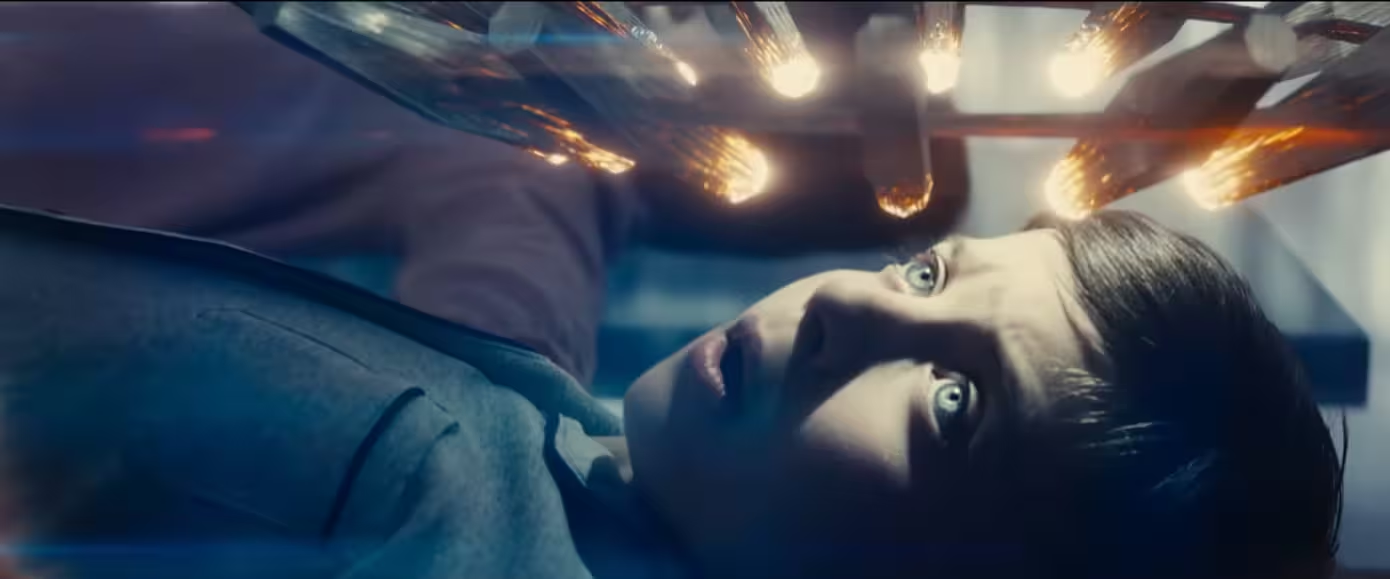
The narrative of Disclosure Day unfolds against a terrifying backdrop: the world stands poised on the brink of World War III. In the midst of this geopolitical panic, Dr. Daniel Kellner, a cybersecurity specialist and whistleblower, steals a massive cache of encrypted hard drives and a highly advanced piece of extraterrestrial technology from his employer, the Wardex Corporation. Wardex is a secretive, independent arm of the United States government that has spent nearly eight decades hiding proof of human-alien contact, dating back to the Roswell incident of 1947.
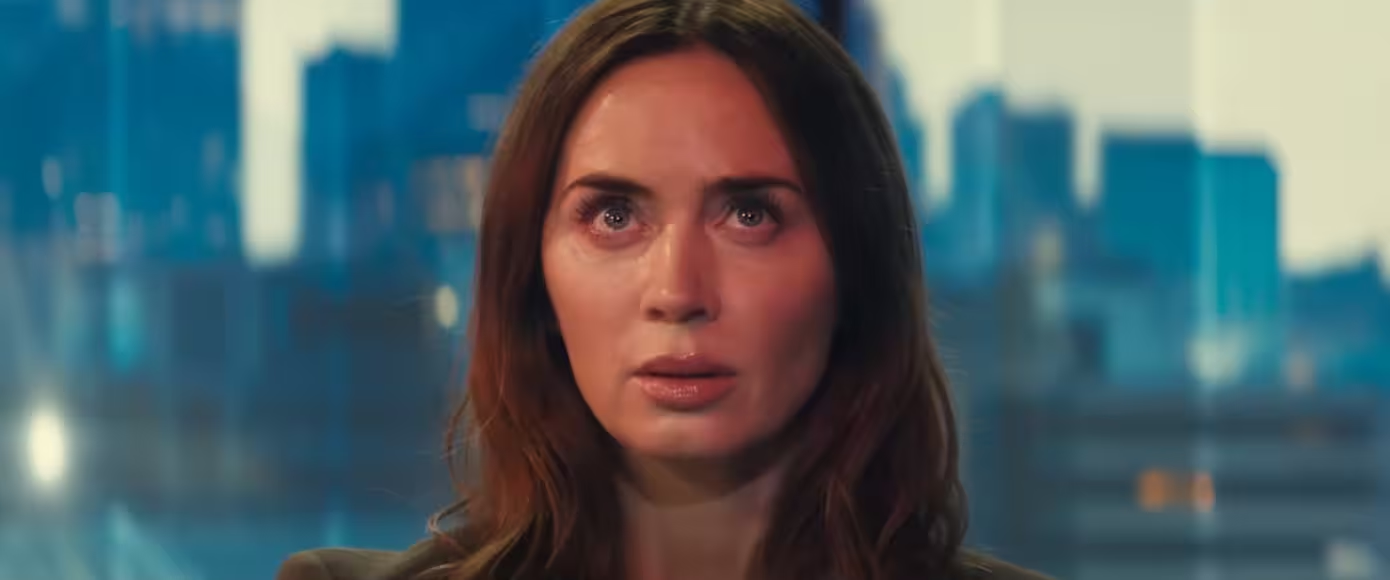
As Kellner goes on the run from Wardex’s ruthless CEO, Noah Scanlon, a parallel crisis occurs in Kansas City, Missouri. Margaret Fairchild, an ambitious television meteorologist, suddenly freezes during a live morning weather broadcast. She begins speaking in a strange, guttural language composed of clicking and popping sounds, subsequently discovering that she has developed latent telepathic abilities.
The film slowly reveals that Daniel and Margaret share a forgotten childhood trauma: both were abducted by extraterrestrials at the age of ten, subjected to neurological experiments, and returned to Earth with dormant, genetically altered cognitive abilities. Together with Hugo Wakefield—a former Wardex Director of Biological Assets turned defector—they race to bypass Wardex’s armed retrieval squads and broadcast decades of suppressed alien footage to a divided world.
Principal Cast and Production Personnel
The ensemble cast brings a grounded emotional weight to a high-concept sci-fi chase, balancing character drama with intensive physical performance.
| Character Name | Actor / Actress | Narrative Significance and Background | Key Technical Prep or Inspiration |
|---|---|---|---|
| Dr. Daniel Kellner | Josh O’Connor | A cybersecurity specialist, mathematical genius, and whistleblower who steals Wardex’s secrets. | Read the entire script in an hour despite his dyslexia, drawn to the unglamorous nature of the character. |
| Margaret Fairchild | Emily Blunt | A Kansas City TV meteorologist who develops telepathic powers and alien linguistic abilities. | Spent months with dialect coaches practicing Korean and Russian; crafted the clicking alien language using her own voice. |
| Noah Scanlon | Colin Firth | The cold, menacing head of the Wardex Corporation who acts as the primary architect of the cover-up. | Sheds his heroic persona to play a weary corporate villain who uses alien tech to telepathically possess others. |
| Jane Blankenship | Eve Hewson | A former Catholic novitiate and Daniel’s girlfriend who gets swept into the conspiracy. | Serves as the moral anchor, experiencing a severe crisis of faith upon seeing captured aliens. |
| Hugo Wakefield | Colman Domingo | Former Wardex Director of Biological Assets who coordinates the whistleblower defection. | Modeled on late Harvard psychiatrist John E. Mack; adopted a Palms-Open physical posture to project empathy. |
| Casper Boyd | Henry Lloyd-Hughes | Scanlon’s ruthless head of security and physical enforcer who stops at nothing to retrieve the tech. | Executes the dangerous train collision stunt to stop the whistleblowers. |
| Jackson | Wyatt Russell | Margaret’s laid-back, baffled civilian boyfriend in Kansas City. | Brings comedic relief, showcasing a normal human reacting to world-altering anomalies. |
| Sister Maura | Elizabeth Marvel | Wise Abbess of the Monastery of St. Clare of the Dawn. | Provides a theological framework to reconcile alien life with traditional Christian faith. |

Streaming Platforms and Distribution Windows
Understanding the film’s availability is essential for modern viewers. Distributed by Universal Pictures, Disclosure Day follows a calculated theatrical-to-streaming pipeline designed to maximize both box office revenue and home viewership.
| Platform / Medium | Projected Release Date | Access Terms & Box Office Rules |
|---|---|---|
| Theatrical Release | June 12, 2026 | Opened exclusively in theaters, securing $44 million domestic and $93 million globally in its opening weekend. |
| Premium VOD (PVOD) | Tuesday, July 28, 2026 | Available to buy or rent on digital storefronts (Apple TV, Amazon Prime Video, Fandango at Home) for $30. |
| Peacock TV (Pay-1 First Block) | Mid-September 2026 | Becomes available to stream for Peacock subscribers exactly 90 days after its theatrical debut. |
| Netflix (Pay-1 Mid-Block) | Mid-January 2027 | Migrates to Netflix for a 10-month exclusive streaming window, reaching a broader global audience. |
| Peacock TV (Pay-1 Final Block) | Late Fall 2027 | Returns to Peacock for the final stretch of the standard 18-month Pay-1 window. |
| Physical Media (4K UHD / Blu-ray) | Fall 2026 | Released alongside a limited-edition steelbook, including a digital copy and behind-the-scenes featurettes. |

Detailed FAQ: Solving Every Narrative Mystery and Hidden Detail
What is the “Device” and how does the alien technology work?
The rod-like, palm-sized alien artifacts are referred to simply as “the Device”. Screenwriter David Koepp opted for this simple name because Spielberg noted that trying to invent a complex, scientific term would sound corny and require unnecessary exposition. Wardex held three of these identical artifacts, recovered from crashed UFOs.
The devices are heptagonal (seven-sided) cylinders forged from Damascus steel—a legendary, high-carbon metal historically used to make durable swords. The Brooklyn-based metalworker who fabricated the physical props suggested adding the seventh side to a standard hexagonal design to make the object feel subtler and more otherworldly.
The technology acts as a mental and physical conduit. It does not have a single, fixed function; rather, its effects depend entirely on the skill, focus, and biological modifications of the person holding it. Known applications throughout the film include:
- Diving (Telepathic Body Mapping): Allows a user to telepathically enter the mind of a target, see through their eyes, and manipulate their motor functions.
- Invisibility Cloaking: Margaret uses the stolen devices to mask Hugo’s group and physical structures from sight by altering how nearby observers perceive light and space.
- Power Generation: Margaret uses a device to instantly restore power to the KCXE-TV broadcast station after Wardex cuts the local power grid.
- Spatial Displacement: Direct bare-handed contact can cause temporary teleportation or phasing out of Euclidean space.
Why couldn’t the Wardex guards shoot Daniel in the opening scene?
In the film’s opening sequence, Daniel is cornered by a heavily armed Wardex tactical unit. Rather than firing, the tactical commander screams, “Stop! Don’t shoot!”.
This restraint is driven by two main factors. First, the alien device Daniel carries is an incredibly unstable, highly concentrated power source. Firing a bullet at or near the device risks triggering a catastrophic energy discharge, spatial collapse, or localized explosion. Second, Noah Scanlon views the device as a priceless corporate asset. His retrieval teams were under strict orders to recover the device and the hard drives completely intact, making lethal force an absolute last resort.
What happened to the goon who touched the artifact with his bare hand?
When Noah Scanlon collapses from the physical toll of telepathically “diving” into Jane’s mind, the dropped device is picked up bare-handed by one of his main enforcers. Under normal operating procedures, Wardex soldiers must wear specialized, insulated gloves to handle the material safely.
When the goon touches the metal with his bare hand, the device reacts violently to his biological field, causing him to instantly “vanish” or phase out of space. He is not permanently disintegrated or “Thanosed”; instead, he experiences temporary spatial displacement. He reappears shortly afterward but is physically incapacitated and deeply disoriented, preventing him from interfering with the final broadcast.
What is the significance of the weird animals appearing throughout the film?
Throughout the movie, characters are haunted by the presence of animals—such as a red cardinal visiting Margaret, or deer and foxes staring at Daniel. During the climax, Hugo Wakefield explains that these animals are actually the extraterrestrials themselves.
Because the physical appearance of “gray” aliens is deeply terrifying to humans, the visitors use their telepathic projection abilities to alter the perception of human observers. By masking themselves as harmless woodland creatures, they can observe humans, guide children safely during abductions, and monitor their test subjects without causing panic.
How does Daniel’s “math synesthesia” work?
Daniel Kellner possesses a unique cognitive mutation resulting from his childhood abduction. He experiences advanced mathematical equations not as dry logic, but as an auditory experience—a sensory crossover known as math synesthesia.
To Daniel, complex numbers and physical codes sound like the clicking and popping language spoken by the aliens. This allows him to read mathematical code as if it were a spoken language. It was this unique ability that originally led to his hiring by the Wardex Corporation.
What is the real-life inspiration for the Richard Nixon and Jackie Gleason scene?
During the film, Daniel reviews classified government footage showing President Richard Nixon giving a tour of a secret alien morgue to a famous actor. Daniel identifies this actor as Jackie Gleason, the star of the classic 1950s sitcom The Honeymooners.
This scene is based entirely on real-world UFO folklore. According to Beverly McKittrick, Gleason’s second wife, the actor was deeply obsessed with extraterrestrials and was a close personal friend of Nixon. She claimed that Nixon, knowing Gleason’s interest, snuck him into Homestead Air Force Base in Florida in the 1970s and showed him the preserved remains of several alien visitors.
To fit the movie’s aesthetic, David Koepp made one slight adjustment: in the real-world legend, the bodies were kept in jars of formaldehyde, whereas the movie depicts them on a modern coroner’s slab.
Why is the 79-year timeline so specific?
Throughout the film, characters state that the U.S. government has been hiding proof of extraterrestrial life for exactly 79 years. Given that Disclosure Day is set in the year 2026, this timeline points directly back to 1947—the year of the famous Roswell incident in New Mexico, where a mysterious object crashed in the desert. By grounding the script in this specific math, Spielberg connects his fictional movie directly to the foundation of real-world UFO mythology.
Where does the corporate name “Wardex” come from?
The name of the corporate-military villain, the Wardex Corporation, is inspired by a real-world bureaucratic government term. While researching transcripts of recent congressional hearings on Unidentified Aerial Phenomena (UAPs), screenwriter David Koepp came across the phrase “waved reporting”.
He adapted this technical term into an acronym: Waved Reporting, Development, and Extraction (WARDEX). The name perfectly evokes a cold, industrial government contractor hiding behind layers of official procedure.
Who is Hugo Wakefield inspired by in real life?
Colman Domingo’s character, Hugo Wakefield, is modeled on Dr. John E. Mack, the late Harvard psychiatrist and Pulitzer Prize winner. Mack became a controversial figure in the 1990s when he began studying people who claimed to have been abducted by aliens.
Instead of dismissing them, Mack argued that their trauma was authentic and deserved to be treated with scientific respect. This inspiration gives Hugo his unique blend of academic authority, deep empathy, and intellectual seriousness.
Additionally, Hugo’s physical habit of sitting with his palms open was a detail added by Colman Domingo, who noticed his husband, Raul, doing it naturally to show openness to whatever life brings.
Theological Themes and Cinematic Parallels
Beneath its surface as a sci-fi chase movie, Disclosure Day explores profound spiritual and philosophical questions, examining how humanity might react to proof that we are not alone in the universe.
      12th Century               1957                    2026
   St. Clare of Assisi      Pope Pius XII        Monastery of St. Clare
   confined to bed; sees    designates Clare     protects Jane; TV signals
   mass on bedroom wall.   as Patron Saint of     broadcast alien footage
                      Television.        to the world.
The Crisis of Faith vs. Cosmic Theology
The discovery of alien vivisections conducted by Wardex triggers an immediate crisis of faith for Jane Blankenship, the former novitiate. She wrestles with whether revealing this truth is morally right, worrying that proving the existence of highly advanced alien life will destroy humanity’s faith in God and upend the Genesis creation story.
In response, Sister Maura points out that Genesis focuses specifically on God’s creation of Earth, and does not rule out the existence of other created worlds. She argues that a vast, empty universe would be a waste of creative energy, and that discovering life beyond Earth simply magnifies the scale of divine creation.
The film contrasts Noah Scanlon’s demonic-style possession of Jane’s mind with her spiritual resistance. While Scanlon uses his alien device like a wizard’s wand, Jane clings to her crucifix, using her personal faith to push back against his telepathic intrusion.
The Patron Saint of Television
When running for their lives, Jane takes Daniel to hide in the Monastery of St. Clare of the Dawn. This choice of name is a highly deliberate thematic setup.
St. Clare of Assisi, a 12th-century saint, was designated the patron saint of television in 1957 by Pope Pius XII. The title was inspired by a miracle: while St. Clare was sick and confined to her bed, she reportedly saw a Christmas mass service projected onto her bedroom wall.
By using her name, Spielberg foreshadows the film’s climax, where television and digital signals are used to instantly share the truth of alien life with the entire world. It reinforces Pope Pius XII’s belief that television is a powerful tool capable of great good or immense harm, highlighting the internet’s power to both unite and divide modern society.
Connective Tissue: Spielberg’s Sci-Fi Legacy
The thematic evolution of Steven Spielberg’s science fiction films reflects his personal growth over fifty years of filmmaking, moving from suburban wonder to geopolitical anxiety.
  Close Encounters (1977)          E.T. (1982)           Disclosure Day (2026)
  Suburban obsession and      Childhood innocence and      A paranoid thriller;
   wonder; peaceful, open     individual connection to    alien tech weaponized
    contact with aliens.       a friendly visitor.        by a corrupt military-
         [6, 29]             [6, 29]          corporate state.
Detailed Scene Deconstruction
The Train Collision Sequence
The train crash in Disclosure Day is a masterclass in practical stunt coordination and physical effects, representing a full-circle moment for Spielberg. The director has often discussed how his career began with a childhood obsession: he would smash his toy trains together until his father threatened to take them away. To preserve the thrill without losing his toys, a young Spielberg filmed the crashes with his father’s 8mm camera, learning how film could capture and control chaotic physical motion.
This sequence also delivers on a stunt Spielberg had originally designed for his first feature film, Duel (1971). In Duel, a truck pushes Dennis Weaver’s car toward a railroad crossing, but the train passes safely before an actual collision occurs. Spielberg later expressed regret that he couldn’t execute a full crash on his limited television budget.
To pull off the sequence in Disclosure Day, the production purchased and modified a real 50,000-pound, 50-foot box car from a train museum in Kentucky. Janusz Kamiński shot the crash on 35mm film, capturing the real weight and kinetic impact of the collision. This practical execution stands out in an era dominated by digital visual effects, giving the sequence a visceral weight.
The KCXE Newsroom and NBC Control Room Sequence
The climactic broadcast sequence showcases Spielberg’s commitment to creating realistic environments on set. Rather than building a generic newsroom on a Hollywood soundstage, the production took over a building at the New Jersey Institute of Technology (NJIT) and transformed it into the fictional KCXE-TV station.
The set was fully functional: all cameras, production consoles, and control monitors were wired together to transmit live feeds. This allowed the actors to react to real images and video playbacks in real-time, eliminating the need for green screens.
For the scenes showing the broadcast spreading across the nation, Spielberg filmed inside the actual NBC News headquarters at 30 Rockefeller Plaza. Directing the control room sequence was an immense challenge. Because the archival alien footage did not exist yet during filming, Spielberg had to direct the actors’ movements and lines based entirely on the screens and pacing he had mapped out in his head, coordinating a complex series of character reactions.
Critical Synthesis
Ultimately, Disclosure Day is not really about aliens; rather, it is a film about human connection, the fragility of truth in the digital age, and the power of empathy. Spielberg uses the classic framework of an extraterrestrial cover-up to explore modern institutional paranoia and societal division, showing how a single, genuine truth still has the power to cut through the noise and bring a fractured world together.
By combining a fast-paced thriller with deeply personal questions about faith and human identity, Spielberg demonstrates that blockbusters can be both thrilling and intellectually complex. The film’s sudden cut to black on the word “Listen” serves as a final, urgent message to the audience, encouraging us to look past our screens, bridge our divides, and genuinely listen to one another.
read more @ cinemedia.media